
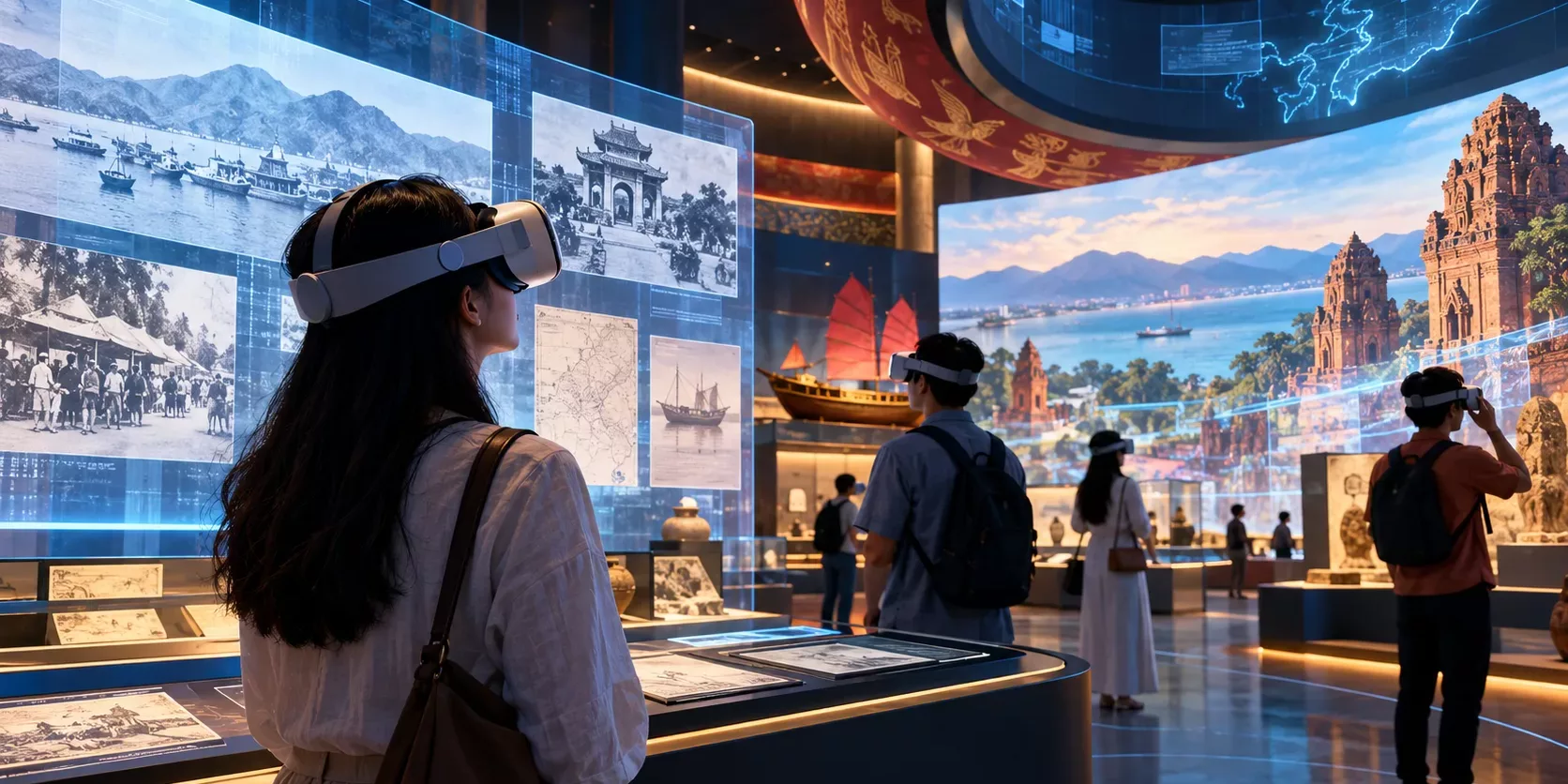
Image: MTECH Digital - AI-generated original illustration — Editorial visualization of VR-supported public history storytelling in Nha Trang.
A public VR experience at Khanh Hoa Digital Technology Festival shows how verified historical content and 360-degree media can support immersive learning.
Key takeaways
- VR can turn archival material into a repeatable public storytelling format.
- Historical review is as important as headset and 3D production quality.
- Hygiene, accessibility, queue capacity and operator workflow determine scalability.
Direct answer: A newly reported virtual-reality experience in Nha Trang demonstrates a practical format for immersive public storytelling: visitors use VR headsets to enter a 360-degree reconstruction of Ba Dinh Square on 2 September 1945, supported by archival imagery, film, audio recordings and historical review. The deployment is relevant to event producers because it packages culturally significant content into a repeatable, walk-up experience rather than treating VR as a technology demonstration.
What was launched in Nha Trang?
On 24 October 2026, the “Returning to Sacred Moments” experience opened at 2/4 Square in Nha Trang as part of the Khanh Hoa Digital Technology Festival 2026. VOV reported on 25 October that the program lets visitors use VR headsets to experience a reconstruction of the moment President Ho Chi Minh read the Declaration of Independence at Ba Dinh Square in Hanoi on 2 September 1945.
The program was organized under the direction of Voice of Vietnam and the Khanh Hoa provincial authority, with VTC News and the provincial Department of Science and Technology involved in delivery. VTC News’ launch report says the Nha Trang edition remained open through 26 October.
How does the immersive experience work?
The verified reports describe a headset-based VR environment using 3D graphics and a 360-degree viewpoint. Participants can look around a reconstructed Ba Dinh Square, see the ceremonial platform and crowd, and hear audio associated with the historic event. VTC News says the production drew on photographs, film, sound recordings and historical testimony, while specialists worked with the technical team to review visual and audio details.
The available sources do not identify the headset manufacturer, display resolution, tracking system, session duration, audience throughput or production budget. Those details should therefore not be assumed when evaluating the installation or estimating a comparable deployment.
Why is this relevant to immersive events?
The event places VR inside a broader public technology festival instead of isolating it as a specialist attraction. The Khanh Hoa provincial portal confirms that the festival ran from 24 to 26 October at 2/4 Square and included approximately 60 booths presenting 5G, smart-city, AI and robotics solutions. Local coverage also documented VR, AR and 3D digitization within the event’s AI and digital-tourism area.
For MTECH and other experiential teams, the useful lesson is the format rather than an unverified hardware specification. A heritage, museum, tourism or civic activation can combine a short guided VR scene with a physical waiting area, contextual displays and staff facilitation. The central design task is to give the visitor one clear narrative objective and ensure the technology serves it.
What should producers validate before adopting the format?
A commercial deployment would still need confirmed testing for headset hygiene, accessibility, queue capacity, operator workflow, multilingual audio, motion comfort and content approval. Historical or institutional projects also require traceable source material and expert review. The Nha Trang program shows the audience-facing potential of immersive history, but the reviewed sources do not establish its technical capacity, cost or scalability.
Bottom line: The Nha Trang installation is a timely Vietnamese example of VR being used as a structured public experience. Its combination of 360-degree reconstruction, archival media and a focused narrative offers a credible reference for museums, destination marketing, education and brand activations built around cultural storytelling.
