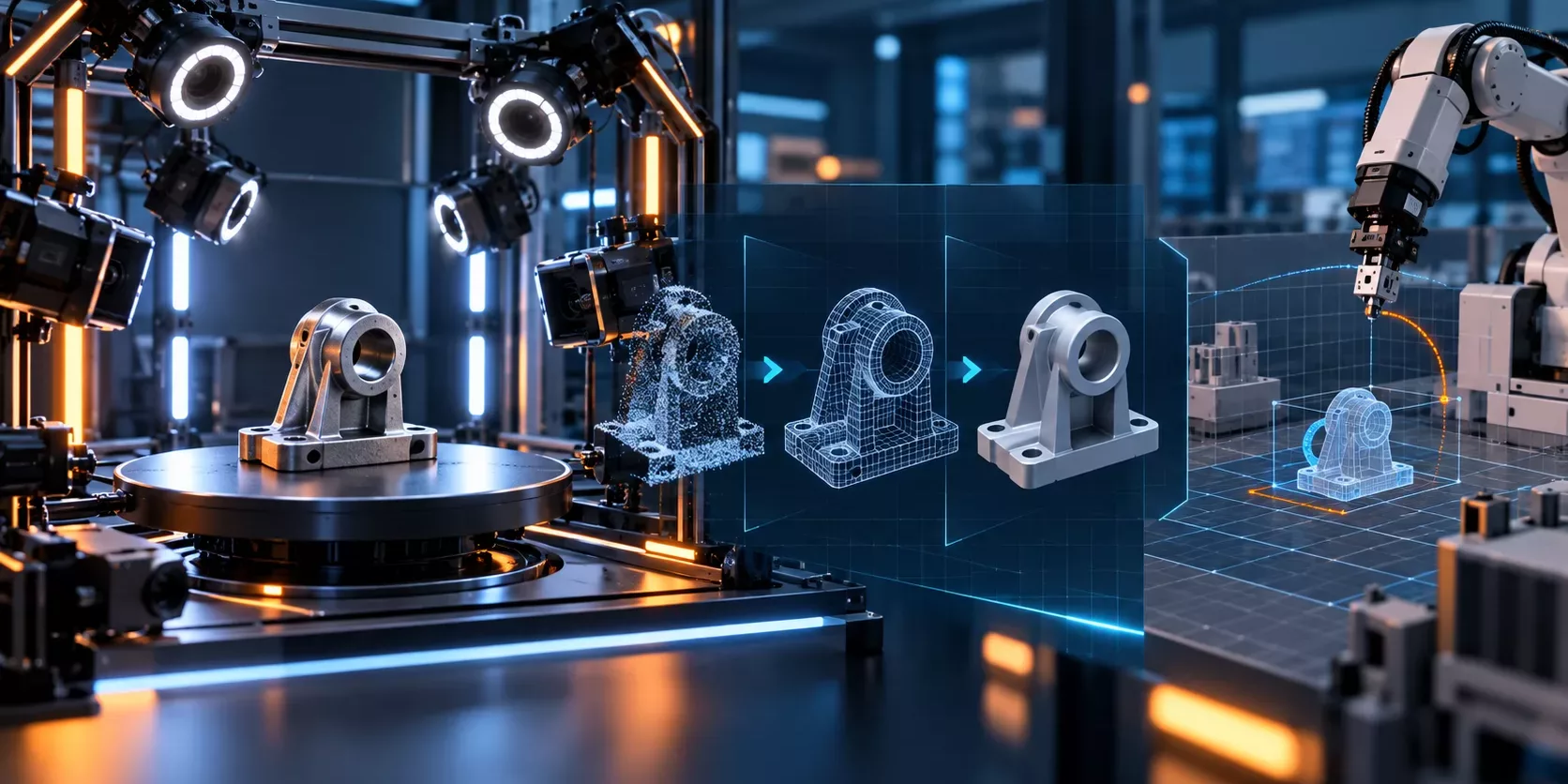
Image: MTECH Digital - AI-generated original illustration — Original editorial illustration by MTECH Digital, created with AI assistance.
ALLSIDES introduced an automated workflow for creating physically grounded 3D assets for robotics simulation at NVIDIA GTC Berlin.
Key takeaways
- ALLSIDES announced the system at NVIDIA GTC Berlin on 20 October 2026 and published its article on 21 October.
- The workflow automates object capture, reconstruction, quality control and delivery of simulation-ready assets.
- ALLSIDES reports sub-millimeter geometry, measured PBR materials and physical properties for the generated assets.
- NVIDIA also described the factory and its SimReady object pipeline in its European retail technology report.
- Before adopting a similar workflow, MTECH clients should assess accuracy, throughput, licensing and integration formats.
What did ALLSIDES announce?
At NVIDIA GTC Berlin on 20 October 2026, Italy-based ALLSIDES announced its 3D Digital Twin Factory, an automated pipeline to convert physical objects into simulation-ready (SimReady) digital twins. The company’s online announcement is dated 21 October. This is a production-system announcement, not evidence that every advertised performance target has been independently benchmarked.
How the pipeline works
ALLSIDES says objects are placed in a capture rig before software automates reconstruction, quality checks and delivery. It describes sub-millimeter geometry, measured physically based rendering (PBR) materials, measured mass and colliders, alongside derived properties such as friction coefficients. Assets can feed NVIDIA Isaac Sim and other simulation workflows; export options listed include USDZ, GLB and OBJ. NVIDIA’s own October report also identifies the new factory and its SimReady object pipeline.
Why ‘SimReady’ matters
A visually plausible 3D object is not automatically useful for robotic training. Simulation benefits from geometry, surface response, and collision properties that approximate real objects. ALLSIDES positions its capture-to-reconstruction system as one way to bridge that gap; users should still validate fitness for their particular simulator and use case.
Practical implications for immersive and interactive experiences
- Digital product storytelling: more consistent asset capture could support interactive catalogs and touch-driven product explorers.
- Spatial twins: reusable measured assets may help populate real-estate, retail and venue simulations.
- AI-driven scenes: structured object data could support later interactive agents or physics-based experiences.
MTECH analysis: event deployments normally face different constraints from robotics training. For a client proof of concept, compare cost per asset, turnaround time, polygon/detail budget, material consistency, licensing, and compatibility with the intended real-time engine before specifying robotics-grade capture.
Evidence and limitations
The capture specifications and early-adopter claims originate with ALLSIDES. NVIDIA corroborates the product launch and broad technology direction, but these sources do not establish independent field performance across all asset categories. ALLSIDES announcement; NVIDIA report.