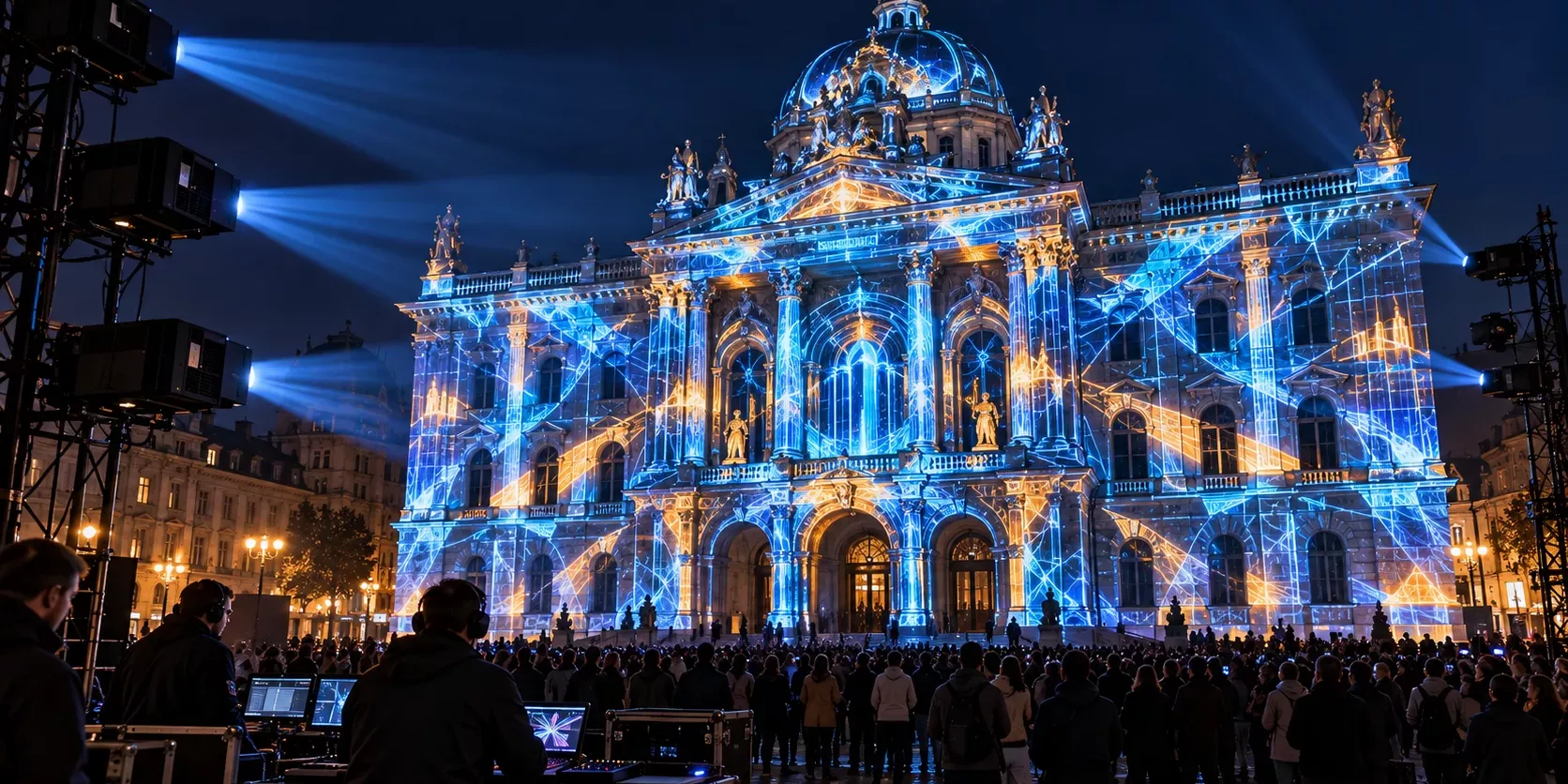
Image: MTECH Digital - AI-generated original illustration — Original editorial illustration by MTECH Digital, created with AI assistance.
At Prague's Signal Festival, Panasonic PT-RQ45 projectors and HIVE Beeblade Pluto players showed a compact approach to synchronized mapping playback.
Key takeaways
- The 14th Signal Festival ran in Prague from 15 to 18 October 2026 and featured 21 installations.
- Panasonic supplied PT-RQ45 4K laser projectors with a specified brightness of 42,000 lumens.
- Seven HIVE Beeblade Pluto players served three installations, with Beesync handling synchronization.
- Felix Frank’s mapping work used the façade of the Archbishop’s Seminary in Dejvice.
- A trade report published on 23 October brought the technical case study into the 19–25 October reporting period.
What was demonstrated in Prague?
At the 14th Signal Festival in Prague, held 15–18 October 2026, Panasonic supported large-format projection mapping with its PT-RQ45 laser projectors and HIVE Media Control’s Beeblade Pluto players. The event had 21 installations overall; that does not mean all 21 used this hardware. Panasonic announced its deployment on 15 October, and specialist publication invidis examined the setup on 23 October, within this newsletter’s reporting week.
Projection and playback in one architecture
Panasonic specifies 42,000 lumens for the PT-RQ45 3-chip DLP laser projector, with a displayed resolution of 3840 × 2400 pixels using Quad Pixel Drive. Its projectors brought Felix Frank’s Missing Interval to the façade of the Archbishop’s Seminary in Dejvice, a newly added festival venue.
Panasonic says seven Beeblade Pluto players were deployed across three installations. The compact HIVE players integrate into projectors instead of requiring the usual external 19-inch rack-based playback setup, while HIVE Beesync coordinates synchronized video output. The configuration was corroborated in invidis’s 23 October report.
What integration does—and does not—prove
Integrating playback can reduce equipment footprint and some cabling complexity. It does not automatically eliminate requirements for lens selection, geometry calibration, content resolution planning, signal monitoring, redundant control or failover. The reported festival case does not provide a complete comparative cost or reliability study.
Implications for MTECH installations
- Large facades: assess projector brightness together with throw distance, ambient light, surface reflectivity and overlap.
- Multi-projector shows: validate frame synchronization, network resilience, edge blending and calibration workflows.
- Event operations: compare integrated players against rack-based media servers for serviceability, redundancy and licensing.
MTECH analysis: for touring or temporary mapping, smaller playback footprints may help simplify builds. For permanent galleries and mission-critical shows, redundant playback and centralized monitoring could remain more important than rack-space savings.
Verification notes
The projector specifications and setup quantities are vendor-reported and supported by independent trade coverage. Festival dates and 21-installation program are sourced to the organizer. The event preceded the reporting week, but the technical case-study coverage was dated 23 October. Sources: Panasonic, invidis, Signal Festival.